


Data Warehousing and Data Mining Concepts and Techniques
Updated on : 2 MAY 2025
Image Source: google.com
Table Of Contents

- 1. Introduction
- 2. Core Concepts of Data Warehousing in Mining
- 3. Differentiating Data Warehousing and Data Mining
- 4. Techniques for Mining Data from Warehouses
- 5. Mining Workflow within a Data Warehouse
- 6. OLAP Functions in Warehousing and Mining
- 7. Use Cases in Retail and E-Commerce
- 8. Healthcare and Life Sciences Applications
- 9. Financial Sector Data Mining Solutions
- 10. Integration with Database Management Systems (DBMS)
- 11. Addressing Data Quality Issues
- 12. Ensuring Scalability and Data Security
- 13. Managing Skill Shortages and System Integration
- 14. FAQs
Table Of Contents

Introduction
Data Warehousing and Data Mining Concepts and Techniques unlock the power of data by storing vast information in one place 🏢 and digging deep to find hidden patterns 🔍. Together, they turn raw data into gold 📊—fueling insights, innovation, and smarter decisions.
Core Concepts of Data Warehousing in Mining
Image Source: google
| 📌 Concept | 📝 Description |
|---|---|
| Data Warehouse | A central repository for integrated data from multiple sources, used for analysis and decision-making. |
| ETL Process | Extracts data from sources, transforms it into a usable format, and loads it into the data warehouse. |
| Data Marts | Smaller, department-specific subsets of a data warehouse focused on specific business areas like sales or HR. |
| OLAP | Online Analytical Processing enables fast, multidimensional queries for reporting and data exploration. |
| Metadata | Information about the data, such as source, format, and update schedule, aiding in data management. |
| Data Mining Integration | Applies algorithms to the warehouse data to discover patterns, trends, and insights. |
| Schema Design | Organizes data in the warehouse using models like Star Schema and Snowflake Schema. |
Differentiating Data Warehousing and Data Mining
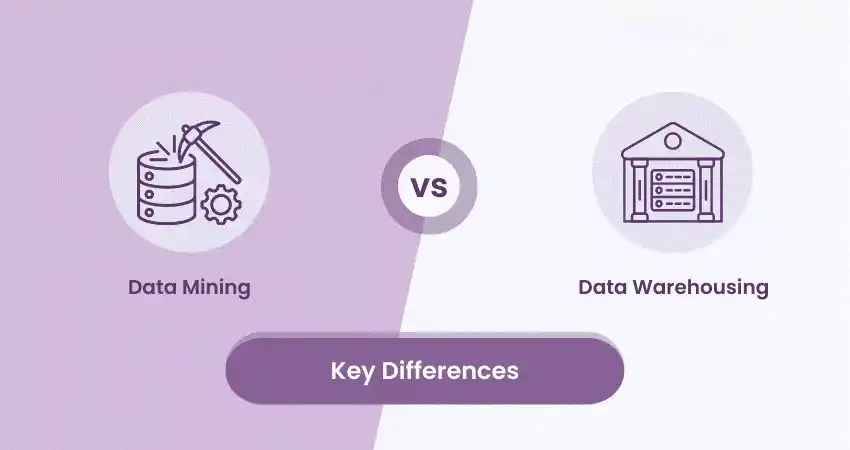
Image Source: google
| 📌 Aspect | 🏢 Data Warehousing | 🔍 Data Mining |
|---|---|---|
| Purpose | Stores and manages large volumes of data | Analyzes data to discover patterns and insights |
| Focus | Data storage, integration, and retrieval | Pattern recognition and prediction |
| Process Type | Prepares data for analysis (ETL, OLAP) | Applies algorithms for analysis |
| Output | Clean, organized historical data | Rules, trends, correlations, predictions |
| Technology Used | ETL tools, OLAP, data marts | Machine learning, AI, statistical tools |
| User | Business analysts, IT staff | Data scientists, analysts |
| Data Type | Structured and historical | Structured, semi-structured, or unstructured |
Techniques for Mining Data from Warehouses
| 🛠️ Technique | 📝 Description |
|---|---|
| Classification | Assigns data into predefined categories using models like decision trees or SVM. |
| Clustering | Groups similar data points together without predefined labels (e.g., K-Means, DBSCAN). |
| Association Rules | Discovers relationships or patterns, like products often bought together. |
| Regression | Predicts continuous values (e.g., sales, prices) based on variable relationships. |
| Anomaly Detection | Detects unusual or rare data patterns that differ significantly from the norm. |
| Sequential Patterns | Identifies frequent sequences over time (e.g., user behavior patterns). |
| Text Mining | Analyzes and extracts useful information from unstructured text data. |

Do you want Database services?

Mining Workflow within a Data Warehouse
As part of Data Warehousing and Data Mining Concepts and Techniques, the mining workflow outlines the systematic process of extracting valuable insights from stored data.
🔄 Step-by-Step Workflow:
- Data Collection and Integration
- Gather data from multiple heterogeneous sources.
- Integrate it into a unified data warehouse.
- Data Cleaning and Preprocessing
- Remove inconsistencies, duplicates, and noise.
- Format and normalize data for analysis.
- Data Transformation
- Convert data into a suitable structure (e.g., aggregations or dimensional formats).
- Use OLAP or dimensional modeling techniques.
- Data Mining
- Apply analytical techniques such as classification, clustering, association rules, and regression.
- Discover patterns, correlations, and trends.
- Pattern Evaluation
- Filter and validate interesting and useful patterns.
- Ensure relevance and accuracy for business goals.
- Knowledge Presentation
- Present results through reports, dashboards, and visualizations.
- Help stakeholders make informed decisions.
- Decision Making and Feedback
- Use mined knowledge for strategic actions.
- Feedback is used to refine models and processes.
OLAP Functions in Warehousing and Mining
| 🧠 OLAP Function | 📝 Description |
|---|---|
| Roll-up | Aggregates data by climbing up a hierarchy or by reducing dimensions (e.g., from city to country). |
| Drill-down | Navigates from higher-level summary data to more detailed data (e.g., from year to month). |
| Slice | Selects a single dimension from a cube to create a sub-cube (e.g., sales in 2024 only). |
| Dice | Selects two or more dimensions to create a more specific sub-cube (e.g., sales in 2024 for region X). |
| Pivot (Rotate) | Reorients the multidimensional view of data (e.g., rows to columns or vice versa). |
| Drill-across | Performs analysis across different fact tables sharing dimensions (e.g., sales vs. inventory). |
| Drill-through | Accesses the underlying detailed data stored in the data warehouse. |
You Might Also Like


Use Cases in Retail and E-Commerce
| 🛍️ Use Case | 🔍 Description |
|---|---|
| 💬 Customer Segmentation | Group customers for targeted marketing based on behavior and demographics. |
| 🎯 Personalized Recommendations | Suggest products based on past behavior to increase sales. |
| 📦 Inventory Management | Predict demand to optimize stock levels. |
| 💸 Price Optimization | Adjust prices dynamically based on demand and competition. |
| 🚶 Churn Prediction | Identify customers likely to leave and take action. |
| 🛡️ Fraud Detection | Detect and prevent fraudulent transactions. |
| 📈 Sales Forecasting | Predict future sales trends to plan better. |
| 🛒 Market Basket Analysis | Discover products often bought together for cross-selling. |
| 💰 CLV Prediction | Estimate customer lifetime value for better targeting. |
| 📣 Targeted Marketing | Deliver personalized campaigns to boost engagement. |

Do you want database management support?
Healthcare and Life Sciences Applications
In the field of Data Warehousing and Data Mining Concepts and Techniques, healthcare and life sciences industries leverage advanced data analysis to improve patient outcomes, enhance research, and optimize operations.
Key Applications:
-
Predictive Analytics for Patient Care
- Analyzes historical patient data to predict future health events or diseases.
- Helps in early detection, treatment, and prevention strategies through Data Warehousing and Data Mining Concepts and Techniques.
-
Drug Discovery and Development
- Uses data mining to identify potential drug candidates and biomarkers.
- Accelerates the drug discovery process by utilizing large datasets and advanced techniques.
-
Personalized Medicine
- Combines patient data with genetic information to tailor individualized treatment plans.
- Optimizes healthcare by using data for more effective and precise treatments.
-
Operational Efficiency
- Enhances hospital management by predicting resource needs and improving scheduling.
- Reduces costs and improves patient flow and care delivery.
-
Epidemiological Studies
- Utilizes data mining to track and predict the spread of diseases and health trends.
- Supports public health interventions and policy decisions.
-
Clinical Decision Support Systems (CDSS)
- Provides healthcare professionals with data-driven insights for accurate and timely decision-making.
- Reduces errors and improves patient safety using Data Warehousing and Data Mining Concepts and Techniques.
-
Patient Behavior Analysis
- Analyzes patient data to predict behaviors like medication adherence or hospital readmission risks.
- Helps in creating personalized healthcare interventions.
Google Cloud Service: Secure and Scalable Solutions for Your Business
Financial Sector Data Mining Solutions
Image Source: google
| 💼 Data Mining Solution | 📝 Description |
|---|---|
| Credit Scoring | Analyzes customer credit history to assess the risk of lending or offering credit. |
| Fraud Detection | Detects suspicious patterns and anomalies in transactions to prevent fraud. |
| Risk Management | Evaluates financial risks using predictive models and historical data. |
| Customer Segmentation | Divides customers into segments based on behavior and demographics for targeted marketing. |
| Algorithmic Trading | Uses data mining techniques to develop automated trading strategies based on market patterns. |
| Portfolio Management | Optimizes asset allocation and investment strategies using data-driven insights. |
| Market Basket Analysis | Identifies relationships between products or services frequently purchased together. |
| Churn Prediction | Predicts which customers are likely to leave based on their behavior and engagement. |
| Loan Default Prediction | Predicts the likelihood of loan default by analyzing borrower data and trends. |
| Anti-Money Laundering | Monitors financial transactions to detect and prevent money laundering activities. |
Financial Sector Data Mining Solutions
| 💼 Solution | 📝 Description |
|---|---|
| Credit Scoring | Assess credit risk based on customer history. |
| Fraud Detection | Identify suspicious transactions and prevent fraud. |
| Risk Management | Evaluate and manage financial risks. |
| Customer Segmentation | Group customers for targeted marketing. |
| Algorithmic Trading | Automate trading strategies based on data. |
| Portfolio Management | Optimize investment strategies. |
| Market Basket Analysis | Identify product relationships for cross-selling. |
| Churn Prediction | Predict customers likely to leave. |
| Loan Default Prediction | Predict loan default risks. |
| Anti-Money Laundering | Monitor transactions to prevent illegal activities. |
Azure Cloud Service: Scalable, Secure Solutions for Your Business
Integration with Database Management Systems (DBMS)
Integrating DBMS with Data Warehousing and Data Mining Concepts and Techniques helps in organizing, managing, and analyzing large sets of data. It ensures smooth storage, access, and analysis of data from various sources.
Key Points:
- Storing Data
- DBMS stores large amounts of data securely and allows easy access. This is important for Data Warehousing and Data Mining Concepts and Techniques.
- It keeps data organized in tables, making it easier to analyze later.
- Combining Data
- DBMS helps bring together data from different places (e.g., from different departments) into one central warehouse for analysis.
- This ensures data is consistent and ready for mining.
- Preparing Data for Analysis
- DBMS helps clean and organize the data by removing mistakes or filling in missing information.
- Clean data is crucial for accurate results in mining and warehousing.
- Efficient Data Retrieval
- DBMS speeds up finding and retrieving data with tools like indexing, making data mining faster and more efficient.
- Complex queries can be run to find valuable insights.
- Real-Time Insights
- DBMS supports real-time data, enabling quick decision-making based on the most current information.
- It helps in analyzing data as it comes in.
- Handling Growth
- As data grows, DBMS can scale up to manage larger datasets without slowing down.
- This ensures that data mining and warehousing continue to run smoothly even with more data.
Addressing Data Quality Issues
| 🛠️ Issue | 🔍 Solution |
|---|---|
| Inaccurate Data | Apply validation and cleaning. |
| Incomplete Data | Fill in missing values. |
| Duplicate Data | Remove duplicates. |
| Inconsistent Data | Standardize formats. |
| Outdated Data | Update regularly. |
| Irrelevant Data | Filter out unnecessary data. |
| Data Integrity | Enforce checks and audits. |
| Data Anomalies | Detect and correct outliers. |
Ensuring Scalability and Data Security

Image Source: google
Scalability
- Cloud Solutions: Use cloud platforms to scale easily in Data Warehousing and Data Mining Concepts and Techniques.
- Load Balancing: Distribute traffic for better performance.
- Data Partitioning: Split data across servers to manage large datasets in Data Warehousing and Data Mining Concepts and Techniques.
Data Security
- Encryption: Encrypt data to protect it.
- Access Control: Use role-based access to secure sensitive data.
- Backup and Recovery: Regular backups ensure data recovery.
- Compliance: Follow regulations like GDPR for data privacy.
Performance Monitoring
- Monitor in Real-Time: Track system performance to avoid issues.
- Optimize Resources: Ensure resources are used efficiently.
FAQs
Q.1. What is data warehousing?
A : A data warehouse is a system used to store large amounts of data from different sources for analysis and reporting.
Q.2. What is data mining?
A : Data mining is the process of finding patterns, trends, and useful information from large datasets.
Q.3. How are data warehousing and data mining related?
A : Data warehousing stores the data, and data mining analyzes it to gain insights and support decision-making.
Q.4. Why are they important?
A : They help businesses make better decisions by organizing data and discovering useful patterns.
Q.5. What are common tools used?
A : Tools like SQL, Power BI, Tableau, and Python are often used for warehousing and mining.
Q.6. What is OLAP?
A : OLAP (Online Analytical Processing) is a tool used in data warehousing to quickly analyze data from different views.
Q.7. What industries use these techniques?
A : Almost all industries — including retail, healthcare, banking, and e-commerce — use them for data-driven decisions.
Q.8. What are common challenges?
A : Handling big data, ensuring data quality, and keeping data secure are key challenges.



Buy, Sell & Rent Properties – Download HexaHome App Now!

Find your perfect home, PG, or rental in just a few clicks.

Post your property at ₹0 cost and get genuine buyers & tenants fast.

Smart alerts & search helps you find homes that fit your budget.
Available on iOS & Android


Available on iOS & Android

Scan to Download our App
Available on iOS & Android – Download Now!

A Product By Hexadecimal Software Pvt. Ltd.